
Medically reviewed by Dr. Nikita Shah, DO, DABOM, FAAFP | Last updated August 18, 2026
“Do I have to take this for life?” It’s one of the first things almost every patient asks me at their first visit — and it’s a completely understandable thing to want to know. But I’ve come to think it isn’t the most useful question to lead with. Here’s how I reframe it with my patients, and what I tend to see happen once someone is about a year into treatment.
Quick Answer
Yes — GLP-1 and GLP-1/GIP treatment can be tapered, paused, or stopped. But obesity is a chronic condition, and most patients who stop without a structured plan regain a meaningful portion of the weight they lost. Whether and how to stop is an individualized decision based on your phenotype, response, and goals — not a fixed timeline.
Why “Will I Be on This Forever?” Misses the Point
Here’s why the “forever” question misses the point: it treats obesity like an acute illness with a finish line, when everything we know about the biology points the other way. Obesity is a chronic, relapsing condition driven by neurobiology — not a willpower problem with a cure date.
Asking “when can I stop” puts you in a waiting position, bracing for permission. I’d rather get you into a building position — shaping the conditions that determine what happens, whether or not medication stays part of the plan.
Better Questions to Ask Instead
If “will I be on this forever” is the wrong first question, what should you be asking? These are the questions I walk patients through:
- Am I willing to see this medication the way I’d see one for blood pressure or thyroid — something I may need long-term to stay well?
- Am I making this decision based on how long I hope to need treatment, or on what my biology actually needs?
- Based on my phenotype and response so far, is a reduced maintenance dose or a supervised taper realistic for me?
- What would need to be true of my lifestyle, muscle mass, and habits to sustain my results long-term?
- What am I building right now that supports me regardless of whether I’m on medication a year from now?
- What does success actually look like for me, beyond a number on the scale?
Some of these questions surface a patient’s own internal bias. Others point toward action — tracking, prioritizing protein and resistance training, checking in honestly with your care team — rather than waiting for time to pass.
This is the core of how treatment is approached at Weight Sense: using Edmonton Obesity Staging System (EOSS) and phenotype-based assessment to individualize not just your starting medication and dose, but the long-term plan around it.
What Actually Happens, About a Year In
Here’s a pattern that shows up often — across patients at our Lake Nona and Moss Park Road locations, our Rosen Care partnership, and telehealth patients across Florida: people start by asking when they can get off medication, or whether they’ll be on it for life. But about a year in, once they’re approaching their goals, something shifts. Medication stops feeling like a crutch and starts feeling like a tool.
They stop asking how to get off, and start asking how to keep going. The early fear — of dependency, of “forever,” of losing control — tends to give way to something more concrete: recognition of what’s actually been built, and a sense that there’s still more to improve beyond the number on the scale.
That shift tends to track with lived experience — fewer food-related intrusive thoughts, travel and social events without anxiety, mobility and energy that keep opening doors. At that point, the internal question quietly moves from “how do I exit” to “how do I sustain this.”
What the Research Shows About Stopping Without a Plan
This isn’t just clinical intuition. In the In the Semaglutide Treatment Effect in People with Obesity 1 Extension Trial (STEP 1 trial extension), patients who discontinued semaglutide after 68 weeks of treatment were followed for a further year off-treatment. Mean weight loss on treatment was substantial — but by one year after stopping, patients had regained roughly two-thirds of that loss, with related cardiometabolic gains reversing as well.
That’s why GLP-1 and GLP-1/GIP medications are approached the way we’d approach medication for any other chronic condition — hypertension, type 2 diabetes — as ongoing management rather than a short course with a hard stop.
If You Do Want to Taper or Stop
None of this means tapering or stopping is off the table. For some patients, once they’ve hit their goals and built strong supporting habits, a lower maintenance dose can be a reasonable next step.
But if you’re facing a coverage or supply disruption, or you’re thinking about stopping on your own for any reason, talk to your care team first, so there’s a plan in place instead of an unplanned gap. This is handled case by case, based on your goals, your phenotype, and a real plan to protect your progress through the transition. If you do restart, re-titration typically happens at a lower dose to prevent side effects.
This should never be a decision made alone or in a moment of frustration. It’s one to plan for in advance, together with your provider.
For most patients, staying on medication longer-term is encouraged. Weight regain is common when treatment stops too early — and if it happens, that’s not a reason for self-blame. Our biology is wired to defend and regain lost weight; it’s not a matter of willpower. Medication is one of the tools that helps keep that biology from winning, which is why maintaining loss is far easier — physically and emotionally — than losing it again through a cycle of regain.
What to Expect Pharmacologically After Your Last Dose
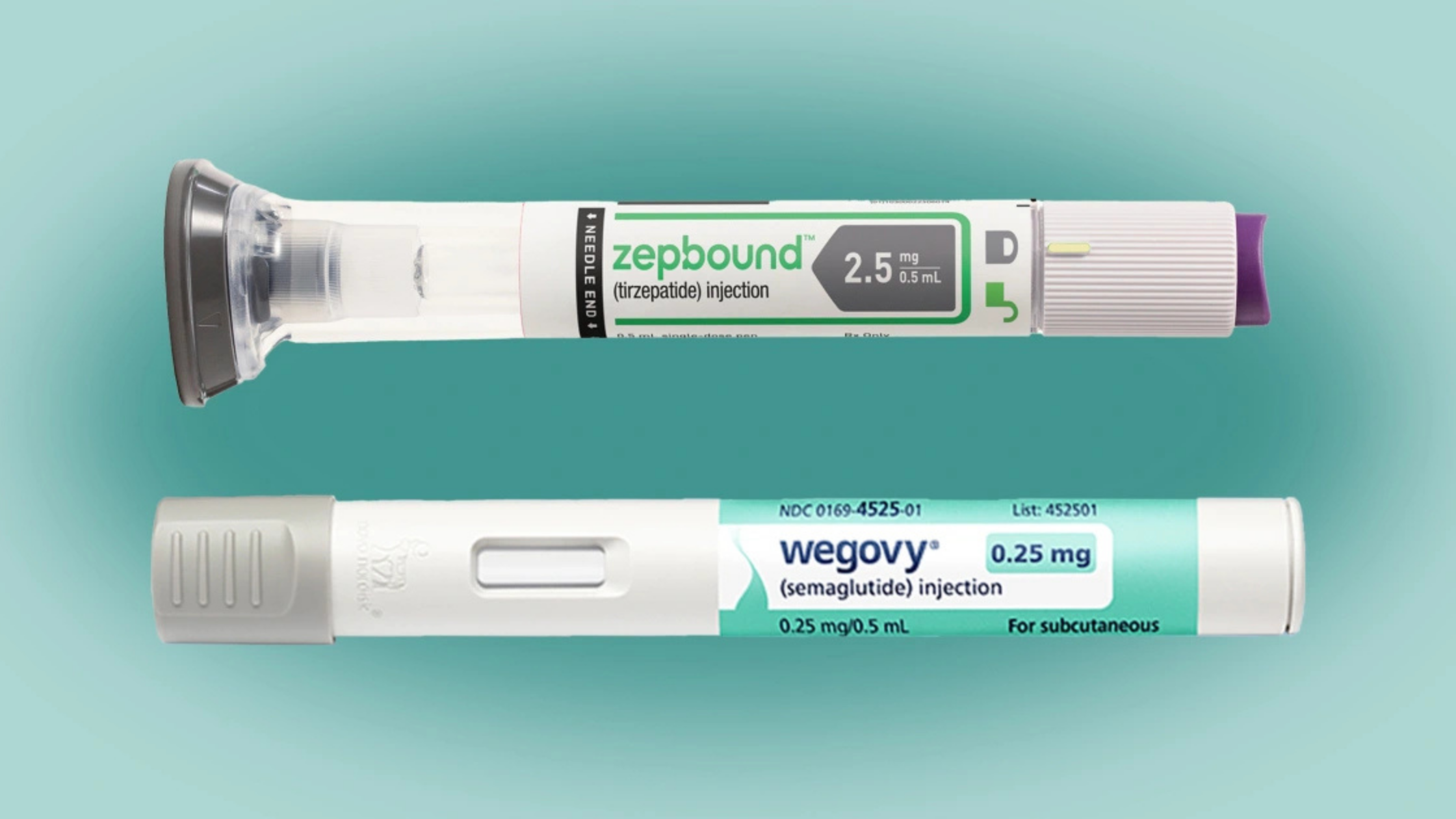
Semaglutide (Wegovy, Ozempic) and tirzepatide (Mounjaro, Zepbound) both have long half-lives, so it generally takes about two months after your last dose for the medication to substantially clear your system. Appetite and satiety effects tend to taper off gradually during that window rather than stopping abruptly. That’s expected pharmacology, not a sign anything went wrong — and it’s something to factor into any taper or discontinuation plan with your provider.
People Also Ask
Will I lose muscle, not just fat, on Zepbound or Wegovy?
As your body changes during weight loss, it’s natural to lose some lean mass along with fat — that’s true of weight loss in general, not just with medication. This is where strategy matters: with adequate protein, resistance training, and tracking body composition (not just the scale), you can protect and even improve your ratio of lean mass to fat over time. See our guide to preserving muscle during weight loss for a full breakdown.
Is a weight-loss plateau a sign the medication stopped working?
Usually not. It’s a sign your body has settled at a new equilibrium — a normal part of the process, not a failure of it. It’s still worth tracking progress against expected outcomes for your specific treatment so you and your clinical team can see clearly whether you’re on goal. Not everyone responds the same way, and that’s not a personal failing. Depending on where you land, there are real options: escalating to bariatric, metabolic, or endoscopic procedures, adding another pharmacotherapy, or continuing to build on lifestyle changes while staying ready for what’s next.
How long does Zepbound or Wegovy stay in your system after stopping?
Both semaglutide and tirzepatide have long half-lives, so it generally takes about two months after the last dose for the medication to substantially clear the body. Appetite effects typically fade gradually over that window rather than disappearing all at once.
Can you restart Zepbound or Wegovy after stopping?
Yes, in most cases. Restarting typically involves re-titrating at a lower dose to reduce the risk of side effects, similar to starting treatment for the first time. This is best planned with your care team rather than self-directed.
Is it safe to stop GLP-1 medication cold turkey?
It’s rarely the recommended approach. Stopping without a plan increases the likelihood of rapid appetite rebound and weight regain, and it removes the opportunity to put a maintenance or taper strategy in place first. Talk to your provider before stopping for any reason, including cost or supply disruptions.
The Bottom Line
Success on GLP-1 therapy isn’t defined by hitting a specific number on a chart, or by how long you stay on treatment. It’s defined by your health — and by having a plan, built with your care team, for whatever comes next. If you’re weighing when or whether to stop, schedule a consultation to talk through your phenotype, your goals, and what a sustainable plan looks like for you.