
You’re eating well. You’re putting in the work. But the number on the scale won’t move — and you don’t know why.
Before you blame yourself, I want to ask you something: How well are you sleeping?
As a board-certified obesity medicine physician in Orlando, Florida, sleep is one of the very first things I look at with my patients. Not because it’s a simple fix — but because it affects nearly everything that matters for weight: your hunger hormones, your stress hormones, your ability to make good decisions, and even hidden medical conditions that could be quietly working against you.
If you’ve been struggling with your weight in Orlando, Lake Nona, Kissimmee, or anywhere in Central Florida — and sleep hasn’t been part of the conversation — it needs to be. Let me explain why.
Your Body Is Making You Hungrier — And Sleep Is the Reason
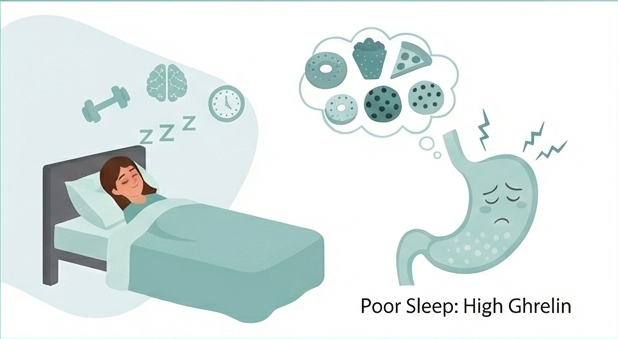
There is a hormone in your body called ghrelin. Its job is to tell your brain when you’re hungry. When you don’t sleep enough, ghrelin levels go up — and that means your hunger goes up too.
This isn’t a willpower problem. It isn’t a discipline problem. It is biology. And the reason this matters so much in weight management is that ghrelin is not a hormone we can directly target with most of our tools. Sleep is one of the only levers we have to naturally keep it under control.
I hear it all the time from my patients: “I don’t know why, but I just can’t stop eating some days.” More often than not, when we dig in, their sleep has been off.
"Many of my patients in Orlando come in doing everything right — except they're running on five hours of sleep and wondering why they're ravenous by 10am. Once we fix the sleep, the cravings start to calm down."
- Dr. Nikita Shah, Weight Sense
So what do you do when a bad night has already happened and your hunger hormones are running high? Here’s a simple, practical tip: make sure every meal that day is intentionally balanced. Focus on:
- Healthy fats — like avocado, olive oil, or nuts — they slow digestion and help you feel full longer
- Protein — one of the best tools we have for keeping hunger under control throughout the day
- Fiber-rich carbohydrates — foods like vegetables, beans, and whole grains that add physical volume to your meals, helping your stomach signal fullness
You can’t always prevent a bad night. But you can absolutely take control of what happens the next day.

Poor Sleep Tells Your Body to Hold On to Fat Cells
Here’s what else happens when your sleep is cut short: your body’s stress alarm goes off. It releases a hormone called cortisol — and when cortisol stays elevated day after day, your body starts working against your weight loss goals.
Chronically high cortisol can:
- Increase fat storage, especially around the belly
- Can lead to insulin resistance and abnormal blood sugar
- Trigger strong cravings for high-calorie, high-sugar comfort foods
- Slow down your metabolism over time
Think of cortisol as your body’s emergency response system. It’s helpful in short bursts. But when it stays on because of ongoing poor sleep, it starts doing real damage — to your metabolism, your weight, and your overall health. This is why sleep isn’t just about feeling rested. It’s a cornerstone of metabolic health.
Exhaustion Makes It Hard to Stick to Any Plan
So poor sleep raises ghrelin and spikes cortisol. But the effects go even deeper than hormones.
Studies show that people who don’t get enough sleep eat more the next day — not just because they’re hungrier, but because they’re also less able to feel satisfied after eating. Their fullness signals are blunted. Their brain pushes them toward calorie-dense foods. And their ability to make thoughtful, intentional decisions drops significantly.
This brings us to something I don’t think gets talked about enough in weight loss: executive function.
Executive function is the part of your brain that helps you plan, organize, and make good choices. It’s what helps you prep your meals on Sunday, say no to the vending machine at 3pm, and stay consistent even when life gets hard. And it is directly impaired by poor sleep.
"You can have the best plan in the world. But a tired brain can't execute it. Sleep is the foundation everything else is built on."
- Dr. Nikita Shah, Weight Sense
This is especially true for patients managing ADHD, brain fog, or high-stress lifestyles. Good sleep doesn’t just support weight loss — it gives you the mental clarity and follow-through to do all the other hard things. If you’re in Orlando or Lake Nona and feel like you keep starting over, this might be why.
Sleep Apnea: The Hidden Condition That Could Be Stopping Your Progress
For many people, the issue isn’t just about sleep habits. It’s about a medical condition called obstructive sleep apnea — or OSA — that is quietly disrupting their sleep every single night without them fully realizing it.
Sleep apnea happens when your airway repeatedly collapses or gets blocked during sleep. Your body briefly stops breathing, jolts itself awake to restart, and this can happen dozens of times per hour. You may not remember waking up. But your body does. And it never gets the deep, restorative rest it needs.
The connection to weight is real and goes both ways: carrying excess weight can make sleep apnea worse, and untreated sleep apnea makes losing weight significantly harder. It’s a cycle we see often — and one that has to be addressed directly, not just hoped away.

At Weight Sense, we screen for sleep apnea as a standard part of our evaluation. Two widely used tools can help identify your risk:
- STOP-BANG Questionnaire — stopbang.ca — screens for OSA based on snoring, tiredness, observed pauses in breathing, blood pressure, BMI, age, neck size, and sex
- Epworth Sleepiness Scale — epworthsleepinessscale.com — measures how sleepy you are during the day and how much it’s affecting your life
If your screening raises a concern, we can order a sleep study directly from our practice. You don’t have to figure that out on your own.
And here’s something worth knowing: there is now a medication specifically FDA-approved to treat moderate to severe obstructive sleep apnea in adults with obesity. It’s called Zepbound (tirzepatide) — and the clinical trial results are remarkable.
The SURMOUNT-OSA phase 3 trials, published in the New England Journal of Medicine, tested Zepbound in two groups: people with moderate to severe sleep apnea who were not on CPAP therapy (Study 1), and people who were already using CPAP therapy (Study 2). The results were significant in both groups:
- In Study 1, Zepbound reduced breathing disruptions by about 25 events per hour — nearly 5 times more than placebo
- In Study 2, for people already on CPAP, Zepbound reduced disruptions by about 29 events per hour — compared to just 6 with placebo
- Overall, tirzepatide achieved up to a 62.8% reduction in the apnea-hypopnea index (AHI)
- Nearly half of all participants — up to 51.5% — saw such improvement that they no longer met the criteria for moderate to severe sleep apnea after one year
What makes this especially meaningful is that the improvement wasn’t just a side effect of weight loss. The medication directly targeted the biology of sleep apnea — not just the number on the scale.
Patients on Zepbound also reported real-life improvements: better sleep quality, less daytime sleepiness, better energy, and a higher quality of life overall.
If you’re curious whether Zepbound might be covered by your insurance, Lilly offers a coverage check tool at lilly.com/zepbound. It’s a good first step before assuming it’s out of reach.
Whether you’re currently using a CPAP device, have never been evaluated, or have been told you snore but never followed up — this is absolutely worth a conversation. At Weight Sense, we look at this routinely. You shouldn’t have to connect these dots alone.
For Women in Perimenopause or Menopause: Your Hot Flashes Are a Weight Problem Too
If you’re a woman in your 40s or 50s living in the Orlando area and you’ve noticed your weight creeping up even though your habits haven’t changed — your sleep may be the bridge between what you’re experiencing and why.
Hot flashes and night sweats, also called vasomotor symptoms, are among the most common symptoms of perimenopause and menopause. And while they’re often described as uncomfortable, what doesn’t get talked about enough is what they do to your sleep — and what disrupted sleep does to your weight.
Every time a hot flash wakes you up, your sleep cycle is interrupted. Over time, this chronic disruption raises cortisol, elevates ghrelin, and leaves your brain too foggy to make the consistent choices that weight management requires.
Treating your hot flashes isn’t just about comfort. It’s about protecting your sleep, your metabolism, and your long-term health. Both hormonal and non-hormonal treatment options are available. And at Weight Sense, we look at the full picture — including where you are in your hormonal journey — as part of your care.
If you’ve been told to just “push through” menopause symptoms, I want you to hear this: you don’t have to. There are options — and treating those symptoms could be one of the most important things you do for your weight.
How Much Sleep Do You Actually Need?
There is no single perfect number that works for everyone. Within a 24-hour period, aiming for 6 to 7 hours is a reasonable baseline for most adults — but some people genuinely feel and function better with more.
Rather than watching the clock, here’s how I actually assess sleep quality with my patients. Ask yourself:
- When I wake up, do I feel rested — or do I still feel tired?
- Am I struggling with brain fog, low energy, or mood swings during the day?
- Am I relying on caffeine just to function — not just to enjoy it?
- Has anyone told me I snore loudly, stop breathing, or gasp in my sleep?
Those answers tell me far more than a number does. If you’re hitting seven hours but still feel depleted every day, something else is going on — and that’s exactly what we investigate at Weight Sense.
Simple Habits That Actually Improve Your Sleep
Good sleep doesn’t always require a prescription. For many people, a few consistent changes can make a real difference. These aren’t rigid rules — they’re boundaries that help your body do what it’s designed to do.

- Cut off caffeine by noon or early afternoon
- Reduce alcohol — it may feel relaxing, but it breaks up your deep sleep cycles
- Move your body during the day — regular physical activity is one of the best things you can do for sleep quality
- Get outside in the morning and get natural sunlight — this anchors your body’s internal clock
- Keep your bedroom cool and dark
- Put screens away in the hour before bed — blue light delays your natural wind-down process
- Go to bed and wake up at the same time every day, even on weekends
If you’ve been treating sleep as optional — something you’ll catch up on eventually — I want to challenge that. Sleep is not a luxury. It is one of the most powerful tools you have for weight management, metabolic health, and your overall well-being.
You Don’t Have to Figure This Out Alone
Weight loss is hard enough on its own. When your sleep is working against you, it can feel impossible — no matter how hard you try or how disciplined you are.
The good news is that when we find what’s actually driving your struggle, things start to change. Many of my patients tell me that addressing their sleep was the turning point — when the cravings calmed down, the energy came back, and the scale finally started to move.
At Weight Sense in Lake Nona, Orlando, we don’t just hand you a meal plan and send you home. We do a full evaluation of your biology — your hormones, your sleep, your metabolism, your body composition, and everything in between. We look at you as a whole person, not just a number on a scale. And we treat you like the intelligent adult you are, with real answers and a real plan.
We serve patients throughout Orlando, Lake Nona, Kissimmee, St. Cloud, Dr. Phillips, and the surrounding Central Florida area. Whether you’re just starting your weight loss journey or you’ve been at it for years without the results you deserve — we want to help you find what’s actually in the way.
Ready to find your missing piece?
Book an Initial Visit at Weight Sense. We’ll evaluate your sleep, your hormones, your metabolism — and everything else that might be working against you. If a sleep study is needed, we can order it directly. This is comprehensive obesity medicine, designed around you.
Because your health deserves more than a one-size-fits-all approach.